
Most Oregon homeowners never think about how the dryer vent gets from their laundry room to the outside of the house. They assume it works, and if clothes take a little longer to dry, they blame the dryer. Usually that is wrong. The dryer vent itself, specifically its length and routing, is one of the most common and most overlooked causes of poor drying performance, higher energy bills, and elevated fire risk.
Here is what you need to know about dryer vent length, why it matters so much, and when it is worth rerouting or shortening your existing vent.
What Building Code Actually Says
The International Residential Code and most local building codes in the Portland area specify a maximum dryer vent length of 35 feet for rigid metal duct, measured as the total developed length from the back of the dryer to the exterior termination. Every 90-degree turn counts as 5 feet of equivalent length, and every 45-degree turn counts as 2.5 feet. So a vent with three 90-degree turns in its actual path only has 20 feet of straight-run capacity left.
Dryer manufacturers often specify their own limits, sometimes more restrictive than code, based on the airflow characteristics of that specific appliance. The manufacturer’s spec in your owner’s manual should always take precedence over the generic code minimum.
Why Length Matters So Much
A dryer vent is not passive. Hot, moist exhaust has to travel the full length of the vent on air pressure generated by the dryer’s internal blower. Every foot of length and every turn in the path adds resistance. A peer-reviewed fire safety study in Fire Technology measured airflow reduction through residential dryer venting and found that vents exceeding manufacturer-specified length lost up to 40 percent of design airflow, which extends drying time, raises internal dryer temperatures, and significantly increases lint accumulation rates inside the vent.
Less airflow means longer drying times. Longer drying times mean more energy use per load. More runtime means higher internal temperatures. Higher temperatures combined with heavier lint accumulation is the exact recipe for dryer vent fires.
Common Vent Length Problems
In many homes, especially ones that have been renovated over the years, the vent runs are much longer than they should be. Common problems include:
- Laundry rooms moved to interior spaces. Second-floor laundry rooms and interior first-floor rooms often have vent runs of 25 to 40 feet because the nearest exterior wall is far from the appliance.
- Multiple turns to navigate framing. Three or four 90-degree turns are not unusual in older homes, which adds 15 to 20 feet of equivalent length.
- Attic or crawlspace routing. Vents that run through unconditioned spaces cool down quickly, causing moisture to condense inside the vent and promoting faster lint accumulation.
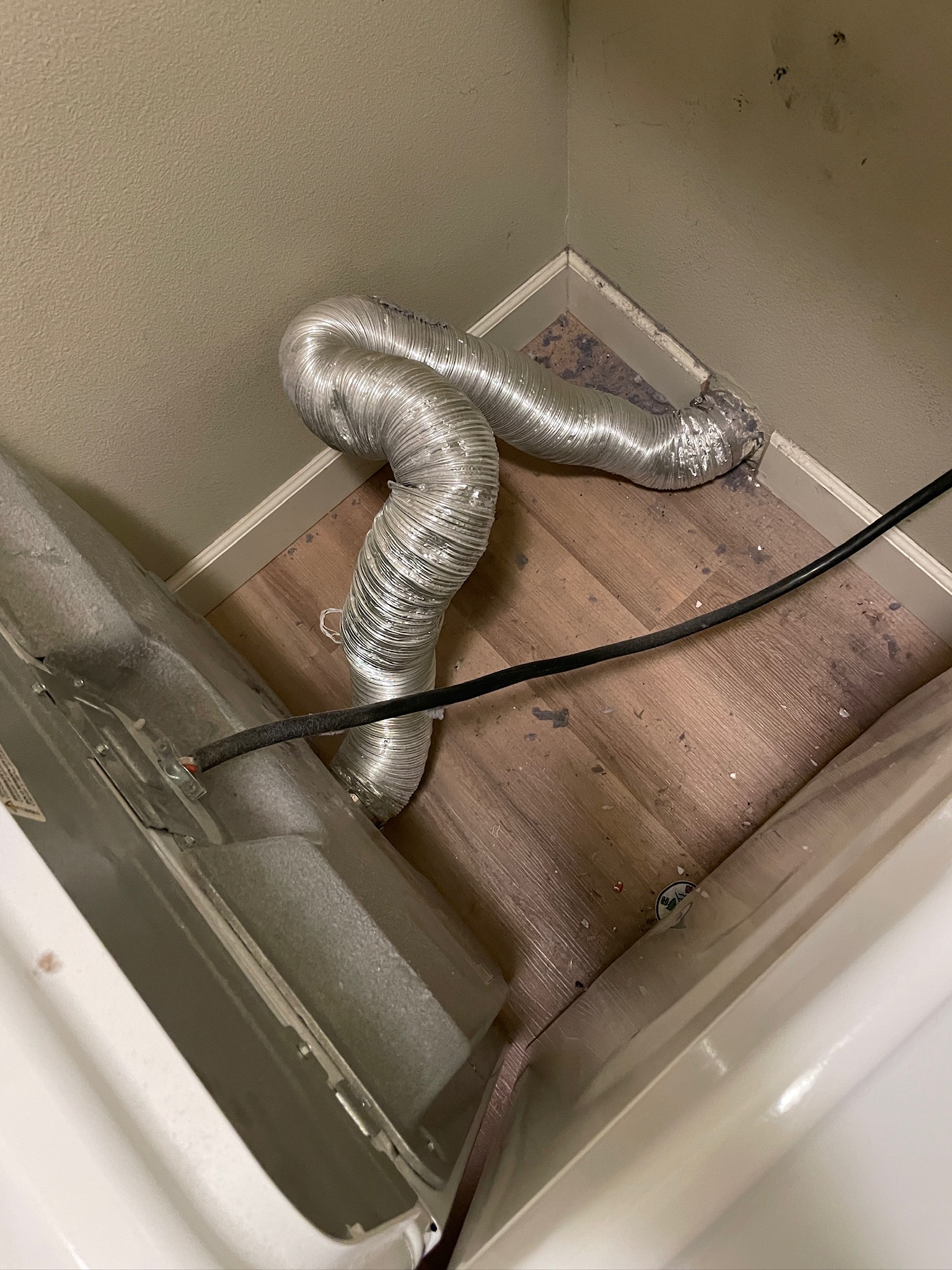
- Flexible foil or plastic vent material. These materials are not code-compliant for most installations, and their accordion-style interior walls trap lint at every ridge.
- Crushed or kinked sections. Behind the dryer where flexible vent gets compressed when the dryer is pushed against the wall.
The Problem With Flexible Plastic and Foil Vent
Flexible plastic and foil vent materials are still common in older installations because they are cheap and easy to work with. They are also responsible for a disproportionate share of dryer vent fires. The ridged interior of flex vent traps lint at every ridge. Plastic vent can actually melt when the dryer runs at high temperatures with restricted airflow.
Current code and manufacturer recommendations require rigid metal duct for the main vent run, with a maximum four-foot section of flexible metal transition duct between the dryer and the main vent. If you still have old flexible foil or plastic in your system, replacing it is one of the highest-impact safety upgrades you can make.
Exterior Termination Matters Too
The vent has to terminate outside the building with a proper vent hood. The hood needs a damper that opens fully when the dryer runs and closes when the dryer is off to prevent backdrafts. Some older installations use louvered covers or screens, both of which trap lint immediately and create chronic blockages.
Signs Your Vent Length Is the Problem
- Clothes routinely take two or more cycles to dry.
- The back of the dryer gets very hot during operation.
- Lint accumulates at the exterior vent within weeks of cleaning.
- Laundry room temperature and humidity rise significantly during operation.
- You hear the dryer motor working harder than it used to.
- A professional cleaning does not solve long drying times.
When to Reroute a Dryer Vent
Rerouting a vent is expensive, but in some homes it is the only real fix. Scenarios where rerouting makes sense include:
- Total vent length over 35 feet with the current path cannot be optimized further.
- Four or more 90-degree turns that could be reduced with a direct path.
- Vent running through attic or crawlspace causing condensation and lint buildup.
- Cannot access the vent for regular cleaning due to how it was built into the structure.
A proper inspection by Dryer Vent John can measure your actual vent length, identify any code violations or restricted sections, and recommend whether cleaning alone will fix the problem or whether rerouting is the right long-term solution.
Getting Your Vent System Right
If your dryer is underperforming, running hot, or accumulating lint faster than it should, vent length and routing are worth investigating before replacing the appliance. Schedule an inspection with Dryer Vent John to get a full assessment of your vent system and a clear path to better performance and lower fire risk.